 BLOKUS PALOOZA 2012
BLOKUS PALOOZA 2012
BLOKUS PALOOZA 2012
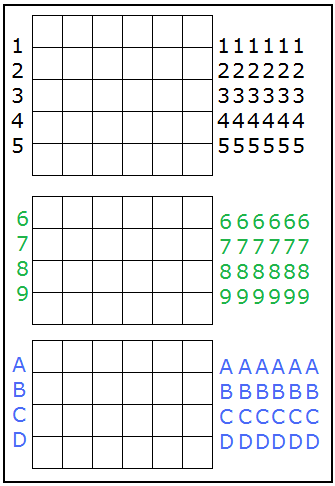
The rows represent the players and their opponents,
and the columns represent the rounds of the tournament.
Start by allocating everyone their 6 games.
The classes of players are represented by different colors
to make the allocation of opponents more visible:
A's are in black, B's in green, C's in blue.
The blue letters A, B, C, D represent player numbers 10-13,
and will so be replaced in the final form of the schedule.
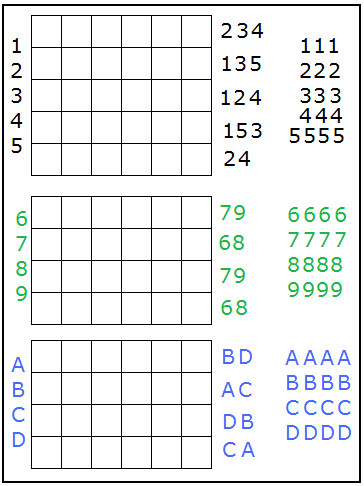 Set up the intra-group games by assigning opponents within groups.
Since there are 5 players in group A, they cannot all play 3 games against other A's because 3 x 5 = 15, an odd number, and it must be even, since two players participate in each game.
Two each would leave a surplus of "vs A" games for the
other players, and four would make for a shortage.
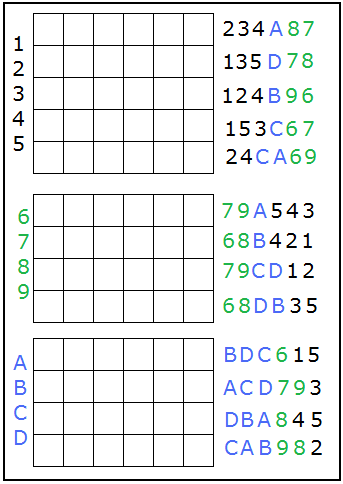
Then add the cross-group opponents.
Since no multiple of 5 up to 30 is divisible by 8,
the number of "vs A" games cannot be evenly distributed
among the other players.
Two of the B's have to play 3 A's,
and two of the C's have to play 2.
The alternative is to have A's play
each other almost exclusively.
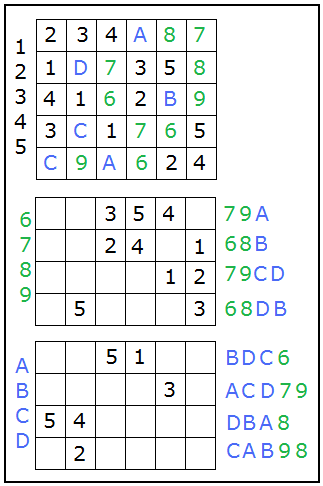 Then assign the games to rounds, starting with the A group.
That ensures they won't have the sitout positions.
Then assign the games to rounds, starting with the A group.
That ensures they won't have the sitout positions.
Numbers are entered in pairs:
For example, when we put the "C" in row 5 of column 1,
we must put a "5" in row C. The Players 5 and C will play
in that round.
This process is like a Sudoku puzzle:
Each column must have each player represented once,
and all the entries in each row are unique as well.
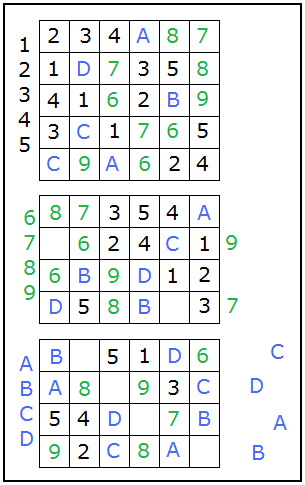
Then fill in the rest of them.
When the number of players is odd, as in this case,
there will be one empty box in each column (all of which
must be different), and the 6 missing entries will be
paired up into 3 games to finish off the schedule,
shown at the right. These must not have already played.
What remains at this point is assigning the Blue/Yellow
colors to each game, balancing those as well.
That, too, usually takes a few iterations.